
A helpful way to think about it
Attachment is like a relationship map: early experiences may sketch the first routes, but later experiences can redraw them.
Understand how we connect, respond to closeness, navigate uncertainty, and develop more secure relationships—without reducing ourselves or others to labels.
Attachment describes the ways we seek connection, reassurance, comfort, and safety with people who matter to us. An attachment pattern is not simply how affectionate someone is: it can shape expectations about whether others will be available, whether needs can be expressed safely, and what happens emotionally when closeness feels uncertain. These tendencies can vary by relationship, life stage, and circumstances.
Attachment is like a relationship map: early experiences may sketch the first routes, but later experiences can redraw them.
People may show different patterns with different people or at different times. No single quiz can define an entire relationship.
Attachment styles describe relationship tendencies. Read about clinical attachment disorders.
Relationship distress can also reflect current behavior, unsafe dynamics, incompatibility, discrimination, stress, or unmet needs—not simply an individual’s attachment history.
Seeking reassurance, withdrawing, or feeling conflicted about closeness may be ways someone learned to manage uncertainty. Understanding the purpose of a response can help change it without excusing harmful behavior.
Repeated experiences of comfort, responsiveness, unpredictability, rejection, or fear can shape expectations about relationships. Temperament, culture, later relationships, and life circumstances also matter.
A child who learns that support is generally available may feel safer seeking help. Someone whose needs were inconsistently met may become especially alert to signs of distance.
Attachment language is intended to increase understanding, not assign blame to parents, caregivers, or partners.
Select an attachment pattern below to explore its core expectations, common reactions to stress, and everyday examples. The explanation will appear here without opening another page. These patterns are descriptive, not diagnoses, and people may recognize more than one.
A useful way to notice a pattern is to ask: What do I expect will happen when I need someone? What do I do when I feel rejected, overwhelmed, or uncertain? What response helps me return to connection? These questions are more informative than trying to fit every behavior into one label.
Attachment language is useful when it creates insight—not when it becomes a shortcut for judging people.
Fact: Patterns can shift with insight, supportive relationships, therapy, and new experiences.
Fact: Withdrawal may reflect discomfort with vulnerability, but behavior and accountability still matter.
Fact: Seeking reassurance is human; the pattern becomes important when fear repeatedly disrupts well-being or relationships.
Fact: Communication, compatibility, safety, and present-day choices are also essential.
Explore which of the four attachment patterns you may recognize in yourself. Think about your usual responses in close relationships—not just one difficult day. This is an informal reflection exercise, not a validated test or diagnosis.
A high reflection score does not establish an attachment style. Consider how safe and consistent your relationships actually are, as well as stress, trauma, culture, and current circumstances. The goal is curiosity and self-understanding, not labeling yourself or a partner.
Attachment tendencies may show up in ordinary moments and across romantic relationships, friendships, and family bonds. The same person can respond differently depending on trust, history, and the other person’s behavior.
One person assumes the other is busy; another worries they did something wrong; someone else may dismiss the need to connect.
One person pursues an immediate conversation, while another needs space. Neither response alone identifies an attachment style.
Some people welcome comfort; others struggle to trust it or feel exposed when receiving help.
Old roles—such as being the peacekeeper or the independent one—may influence how someone asks for support.
Fear of being excluded, difficulty trusting, or comfort with mutual dependence can affect friendships.
Closeness, commitment, communication, jealousy, and responses to conflict may bring attachment patterns into focus.
Sometimes one person responds to uncertainty by seeking more contact while another responds by withdrawing. This can create a repeating pursue–distance cycle.
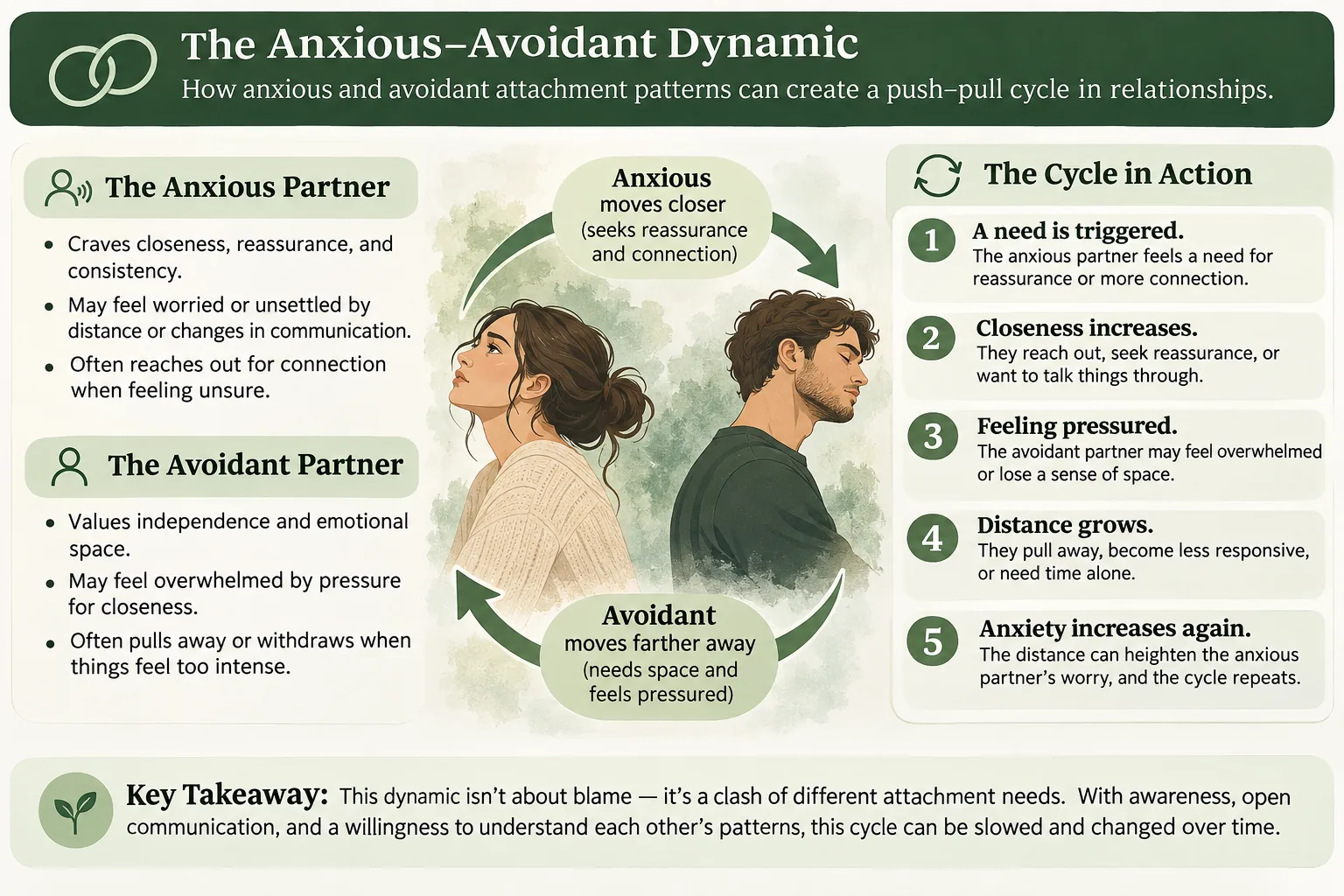
One partner feels disconnected and asks repeatedly for reassurance. The other feels overwhelmed and retreats. The retreat increases the first partner’s anxiety, which increases the pressure.
Name the pattern without blaming either person. Agree on predictable check-ins, respectful time-outs, and a clear plan to reconnect.
Use these prompts to notice tendencies without assigning yourself a permanent label.
What happens in my body when someone important feels distant?
Do I usually seek closeness, withdraw, become conflicted, or respond differently depending on the relationship?
What helps me feel emotionally safe, and how do I communicate that?
Which relationship patterns do I want to strengthen or change?
Recognizing an attachment trigger is the first step toward responding with greater awareness. Notice what feels threatening, how you instinctively protect yourself, and what you actually need. Then practice communicating that need, repairing disconnection, and building trust through consistent actions.
“When plans change suddenly, I start worrying that I do not matter.”
“I send several messages,” or “I shut down and say I’m fine.”
“I need a clear update,” or “I need a short break and reassurance that we will return to this conversation.”
Notice which people respond consistently when you express a need. For words to use, try the Boundary Builder or practice repairing a disagreement.
Consider professional support when relationship patterns repeatedly cause distress, interfere with daily life, or feel difficult to change despite your efforts.
Individual, couples, or family therapy may help with communication, emotional regulation, boundaries, and relational experiences.
Attachment work should never be used to excuse coercion, threats, or abuse. If a relationship feels unsafe, prioritize safety and appropriate support.
Explore trust, emotional availability, compatibility, and connection.
Learn about conflict cycles, repair, healthy limits, and people-pleasing.
Recognize manipulation, coercive patterns, and pathways toward safety and recovery.
Explore • Understand • Grow · Educational information only; not a substitute for individualized assessment or care.